Sometimes a taxi journey leaves an unpleasant aftertaste: the driver arrived later than promised, the price was higher than shown in the app, the car was dirty, or the driver was rude. A clear, factual complaint sent to the right organisation is the best way to have the problem looked at.
4000taxi.com is a directory. It does not take bookings and cannot handle complaints about journeys, so use the routes below.
Main options where you can complain
There are several routes, and each one deals with different problems:
- The app or operator. If you booked through an app (for example Uber, Bolt or FREENOW), open your trip history, select the journey and use the in-app help or report option. If you booked a minicab by phone or online, contact the company you booked with.
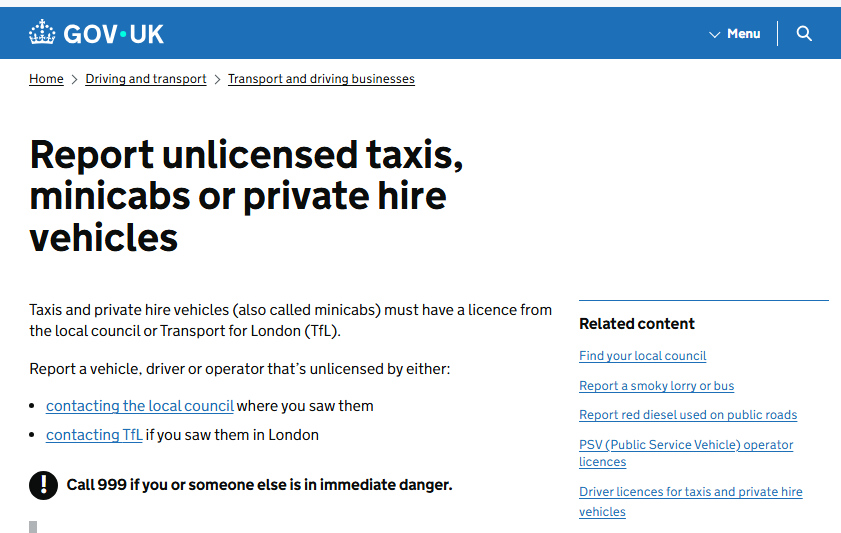
- The licensing authority. Outside London, taxi and private hire licences are issued by the local council. In London they are issued by TfL, and in Northern Ireland by the Driver & Vehicle Agency (DVA). Complain to the authority that licensed the driver or vehicle (see below).
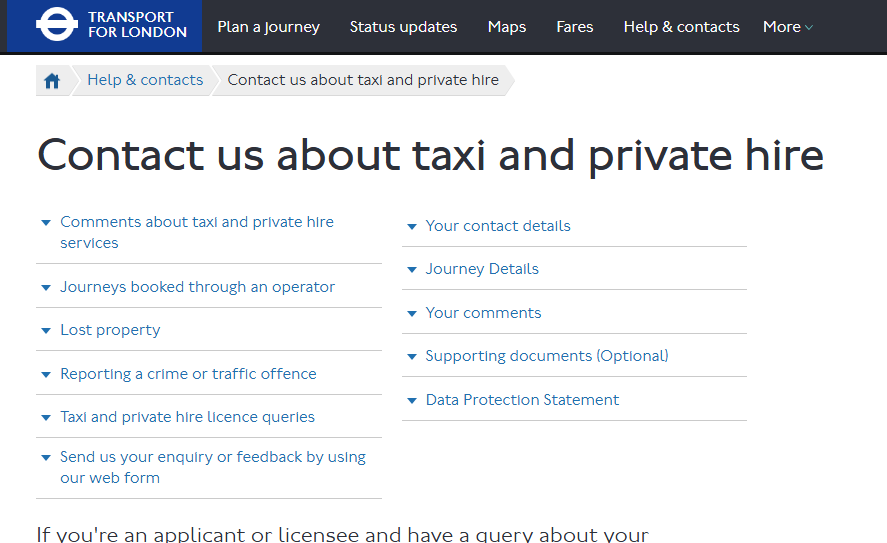
- Transport for London (TfL). In London, TfL licenses black cabs and minicabs. For a booked journey, contact the operator first if the driver was late or the car was dirty. Complain to TfL directly about driver behaviour, overcharging, refusals, card-payment problems, any black cab hailed in the street or taken from a rank, or an operator that did not deal with your complaint properly.
- Police. Call 999 if a crime is happening or someone is in immediate danger. For crimes that are not an emergency, call 101 or report online.
- Northern Ireland. Complain first to the driver or taxi operator. Operators must record complaints. If it is not resolved, report it to the DVA Passenger Transport Licensing Division. Report unlicensed taxis to the PSNI.
Before choosing a channel, think about how serious the problem is. Lateness or a dirty car usually starts with the app or operator. Driver behaviour, overcharging or safety concerns can go to the licensing authority, and anything criminal to the police.
How to prepare a complaint
The process is simple:
- Collect the details. Booking reference, the driver’s name or badge number, and the car’s registration plate. If you booked through an app, most of this is in your trip history.
- Describe the situation. Briefly and factually: where, when and what happened.
- Save the evidence. For example a screenshot of the fare, a route map, a photo of the interior, or messages with the driver or support team.
- Choose how to send it. Online form, email, letter or phone call, depending on what the organisation offers.
Important: the complaint must be specific.
What screenshots to attach
Attach anything that supports what you say:
- a receipt with the amount and time of the trip;
- a route map, if the driver took a longer route;
- the driver’s profile with the name and photo;
- chat messages (if any);
- a photo of the interior if you are complaining about cleanliness or safety.
“He was rude” is vague. “The driver shouted and refused to stop when asked” gives a clear picture.
Complaining to a council
Complain to the council that licensed the driver or vehicle. You can find it on the driver’s badge and the vehicle’s licence plate or sticker. It is not always the council for the area where you travelled.
The steps are:
- Check the badge or licence plate to see which council issued the licence.
- On the council’s website, look for the taxi and private hire licensing pages. Most have a complaint form or a licensing contact.
- Give the driver’s name or licence number, the vehicle registration, the date and time, a description of what happened, and your contact details.
The council can suspend or revoke a driver’s licence, with immediate effect if public safety requires it.
What to expect after filing
For a fare dispute or a late car, the operator may offer a refund, depending on its own policy. More serious complaints may be investigated. In London, TfL can suspend or revoke a driver’s licence, and in serious cases the suspension can take effect immediately.
If you hear nothing, follow up by email or phone. If you have completed the council’s complaints procedure and are unhappy with how the council handled it, you can go to the Local Government and Social Care Ombudsman (England), the Public Services Ombudsman for Wales, or the Scottish Public Services Ombudsman. The ombudsman looks at how the council dealt with your complaint, not at the driver. In Northern Ireland, send unresolved taxi complaints to the DVA’s Passenger Transport Licensing Division.
Practical tips and common mistakes
A few things make a complaint easier to deal with:
- Keep receipts. Especially if you pay in cash, as without a receipt it is harder to prove the trip took place.
- Do not delay. Complain while the details are fresh.
- Be precise about what you want. “I would like a refund of the difference” is clearer than “I was outraged by this”.
- Stick to the facts. Official bodies need facts, not emotions.
- If you are threatened, contact the police. An app’s support team is not a substitute for the emergency services.
A common mistake is a general complaint with no details. It is likely to get a template reply.
Result
If a journey went wrong, report it to the right place: the app or operator, the licensing authority (the council, TfL in London or the DVA in Northern Ireland), or the police if a crime was involved. A short, factual description with screenshots gives your complaint the best chance of being dealt with.
Sources
- GOV.UK: Taxi and private hire vehicle driver licence
- TfL: Contact us about taxi and private hire
- TfL: Compliance and enforcement
- nidirect: Making a complaint about a taxi service
- GOV.UK: Contact the police
- Birmingham City Council: Taxi and private hire
- Local Government (Miscellaneous Provisions) Act 1976, section 61
- Private Hire Vehicles (London) Act 1998, section 17
- Local Government and Social Care Ombudsman: Taxi and private hire vehicle licensing
- Public Services Ombudsman for Wales
- Scottish Public Services Ombudsman